
By Kelly McBride, Safari Specialist for The Wild Source
I’ve been on a lot of safaris over the years. I’ve driven across thousands of miles of Africa and walked through a fair bit of its wilderness too. I love all of it — the animals, the landscapes, the sense of being away from regular life.
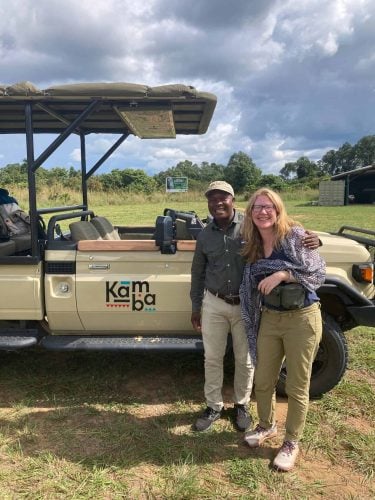
So I was thrilled when The Wild Source asked me to go to The Republic of Congo to spend 7 nights in Odzala Kokoua National Park on a trip organized by Kamba. I wasn’t sure how the safari would compare to something more traditional and now that I have done it I can say simply that it is not better or worse – just different. More physical. More immersive. More sensory. Less comfortable in some ways, but also more real. I loved it.
Here’s what the trip felt like for me, start to finish.
The 2 hour charter flight from Brazzaville to Odzala revealed landscapes below that were entirely new. I’ve heard the dense forest areas aptly described as broccoli crowns. There was only one red dirt road that followed our flight path and very rarely a village alongside it. I’d like to drive that road someday. On arrival at Mboko Airstrip I saw a familiar face, a guide I’d known in South Africa from several years back. It was a reminder that even way off the beaten path we are still connected. There is no guide training program in the country so Kamba is in the process of training Congolese guides to take on the role. This will be a real achievement and a win for both guides and guests to experience Congo’s wild places though the lens of a local.
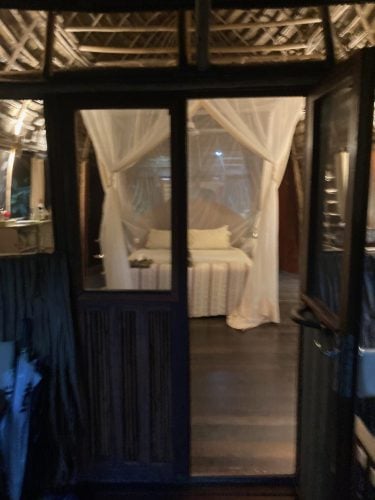
At Ngaga Camp, the first of the 3 camps we would stay at, I was completely charmed by my forest bungalow and the wonder of sleeping perched among the trees that ascended from the forest floor well below my room and towered onwards high above.
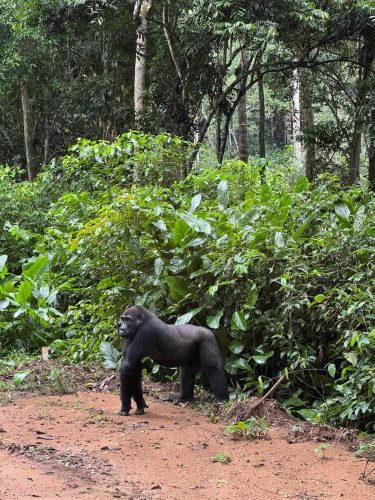
From camp we had 2 days of trekking to find the habituated Western Lowland Gorillas in the area. The max group size here is 4 and the treks varied from very easy to somewhat challenging (happy to elaborate for anyone wanting to know more). Just like in Uganda and Rwanda the guides will ask your preference and do their best to accommodate. Unlike mountain gorillas, the lowland gorillas spend a lot of time in the trees which showcase their strength and agility with behaviors like climbing and resting with their full weight balancing on remarkably thin vines.
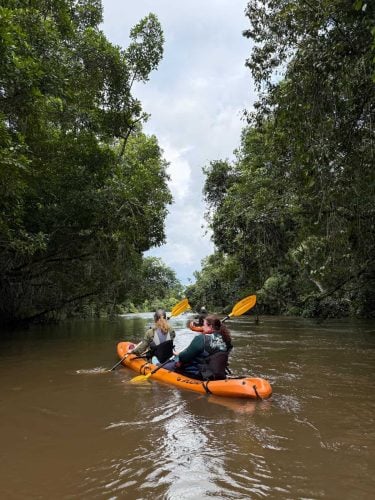
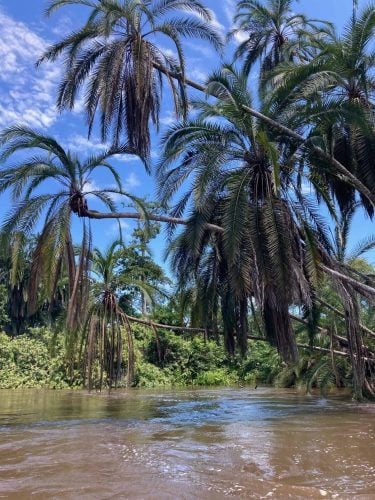
To get to our next camp in Lango Bai, we kayaked along the Lekoli River. It was calm, slow, and an exhilarating change from the forest setting. African Gray Parrots, one the most trafficked birds in the world, flew freely overhead. At one point we saw a flock of roughly 100. The water was smooth, the air warm, and I would have been happy to continue this way all afternoon.
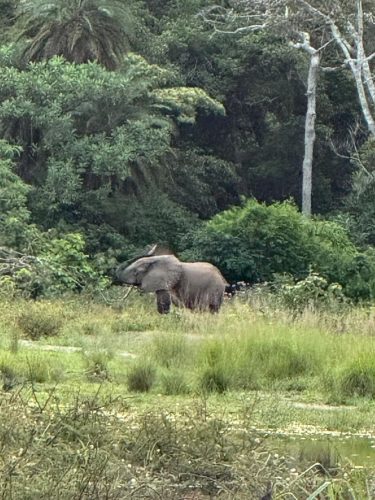
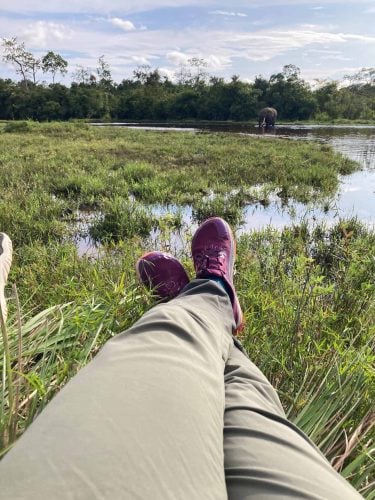
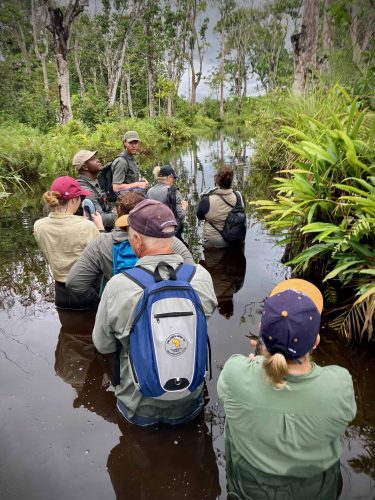
After about 45 minutes we entered a side channel and moored the kayaks, only to step back into the water to begin our walk toward Lango Lodge. Our guides led us with quiet confidence and gave a hand when a log crossed our path under the knee deep water. When the baï came into view, it felt like stepping into a completely different ecosystem. We saw hippo and buffalo tracks, and the baï stretching out in front of us like a giant natural arena. Forest elephants come to the baï primarily at night to mine for minerals under the water. They use their tusks to loosen up the silty soil, and their trunks to blow bubbles bringing the minerals to the surface where they are consumed. This was another unique behavior I’d never seen from elephants. We were lucky that on our arrival, despite the daylight, a lone elephant bull stood at the forest’s edge using his solitary tusk to root around the water. We trudged through the water towards him, trying unsuccessfully to be quiet, until we reached our camp accessed by a wooden boardwalk emerging from the water.
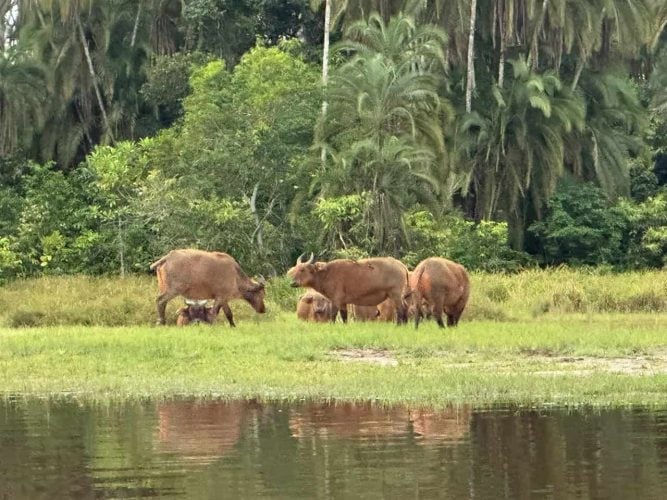
Once settled in, a large elevated deck was a comfy spot to observe the wildlife that comes out of the forest to drink, graze and wallow in the shallow waters. Forest buffalo, bushbuck and red river hogs made appearances in the bai during our stay. In the surrounding forest by our rooms, colobus monkeys came and went but the territorial call of the nocturnal palm civet will stay with me for a while.
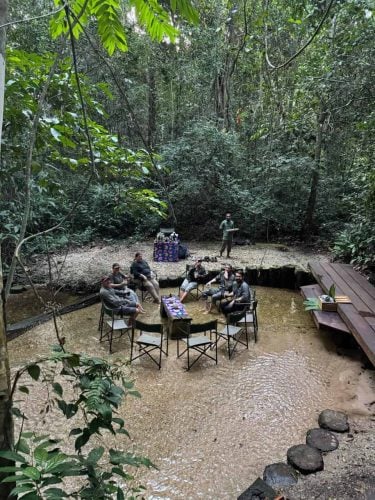
We explored Lango on foot through its copper colored water that ranged from ankle to waist deep. Sometimes we stepped up and out of the water into a forest full of trees losing their fight against healthy strangler figs. Other times we stepped out into unexpected prairie like grasslands dotted with special flowers. Eventually we returned to the water to find our way back to camp. I loved everything about this experience, especially the cacophony of sounds that accompanied us on our walks from the birds, bugs and frogs that are lucky enough to live here.
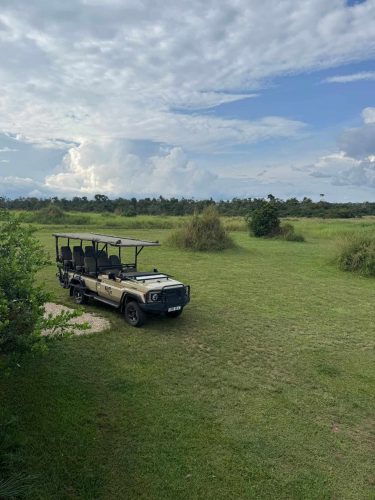
At Mboko Lodge, our last camp, the forest opens into the savanna. I didn’t realize how much I’d gotten used to the cocoon of trees until the landscape shifted. Our arrival here almost signaled a reminder that we would have to leave eventually and this camp serves as that transition.
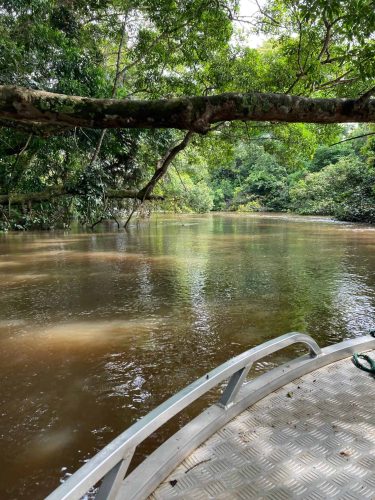
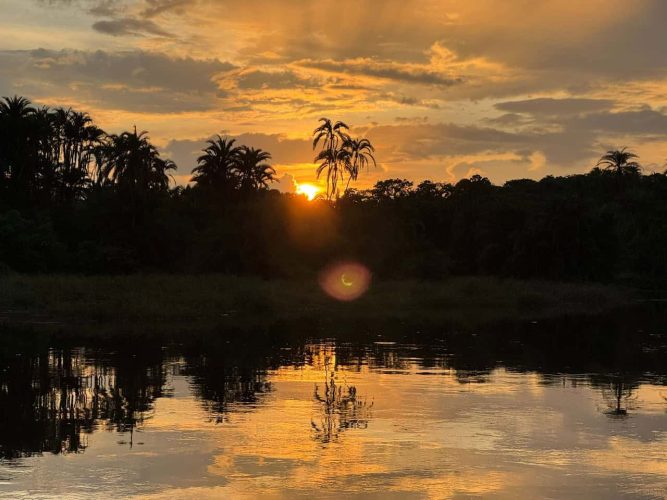
We boated the river that afternoon and were treated to a hippo displaying wildly. After the mud and the deep forest days, the time in the motorboat felt easy and relaxed with great birdlife and jungle views. From the boat, we still ventured out on foot but we also spent a little more time in the vehicle moving between camp and the jetty which gave the avid birders in the group an opportunity to photograph the countless new species including the chocolate-backed kingfisher and abundant bee eaters.
On our last night, the savanna biome delivered a familiar resident as a spotted hyena, the apex predator in the park, stopped by our farewell dinner. Even this sighting felt unusual as the hyena came alone out of a damp dense forest fed by a river at the boundary of the camp. She appeared to be a pregnant female and I saw her again early the following morning walking across camp heading back towards the same area. Like the other mammals we’d seen she was familiar and yet unique somehow in this special setting. She left me curious and wondering.
After all the safaris I’ve done, this one felt fresh, grounding, honest and deeply memorable.
The Congo Basin isn’t a “typical safari,” and that’s exactly why it stands out. Here’s what made it different for me:
If you’re inspired to visit the Republic of Congo, you can follow Kelly’s route—or use it as a starting point for your own custom adventure. Check out our sample itinerary below.