
By Katt Hendershot, Operations Specialist for The Wild Source
Mountain lion, puma, panther, wildcat, catamount, painter, cougar—different names, same animal. Puma concolor holds the Guinness record for the animal with the greatest number of names, a species so widespread and culturally significant that in English alone it has more than 40. Historically ranging from Northern Canada to South America and from coast to coast, these cats are adaptable to many environments. Though largely extirpated from the eastern United States, they remain populous in many regions, including Los Angeles, one of only two megacities (over 10 million residents) where large cats live.

When it comes to common names, “mountain lion” is used mostly in the western United States, “cougar” in the eastern United States and in Canada, and “puma” in Europe, Central, and South America. New England sometimes uses “catamount” (short for “cat-of-the-mountain”). These names aren’t limited to those regions, and you may hear them used elsewhere. “Panther” can refer to many types of cats, usually those in the genus Panthera. In Florida, there is a subspecies,Puma concolor coryi, that are named Florida Panthers.
Though they are colloquially looped into the Big Cats, they actually are not! Big cats are any of the five living members of the genus Panthera. These cats have a flexible, cartilaginous hyoid bone and a specialized larynx with vocal cords that allow them to roar. Mountain lions do not have this alongside cheetahs which are also commonly referred to as a big cat.
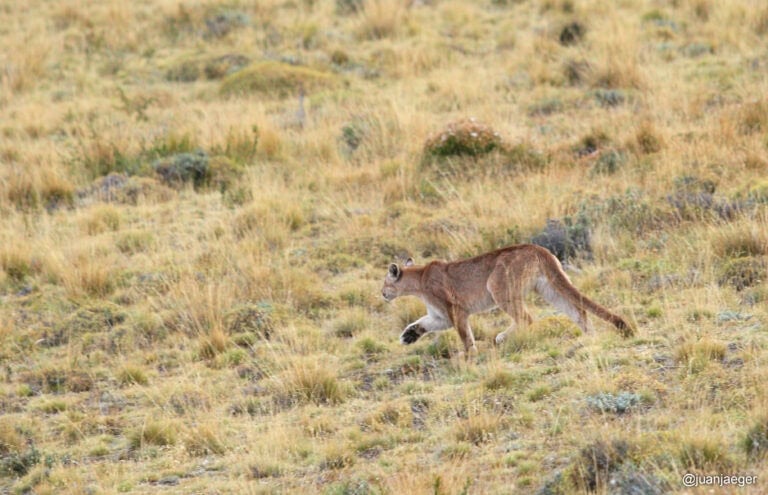
In the western United States, male mountain lions typically weigh 130–150 pounds. Following Bergmann’s rule, which states that mammals tend to be larger farther from the equator, male pumas in Chile can reach 150–220 pounds. Cougars can have litters of one to six cubs who are born with spots that fade within 6 months and look similar to Cheetah cubs.
Mountain lion attacks are extremely rare, with only 20–30 fatalities recorded in the United States and Canada over the past 120 years. Most victims have been children. You may have seen viral videos with headlines like “Cougar stalks hiker!”—but what’s usually happening in those clips is a behavior called escorting, when a female tries to drive people away from her young. If a mountain lion were truly stalking you, you wouldn’t know it. For safety tips on recreating in mountain lion country, visit the National Park Service website.

Pumas are elusive and rarely seen in the United States and Canada. For those hoping to spot them, one of the best places in the world is Patagonia, Chile, where a thriving population has become unusually visible. After hunting was banned, pumas found sanctuary in the breathtaking Torres del Paine National Park. Over generations, sightings grew increasingly common, to the point where visitors can now reliably watch them, even as they hunt guanacos, a wild, llama-like relative.
Mountain Lion Names
- Puma
- Cougar
- Couguar
- Panther
- Panthere
- Painter
- Catamount
- Wild Cat
- American Lion
- California Lion
- Silver Lion
- Mountain Devil
- Mountain Lion
- Mountain Demon
- Mountain Tiger
- Mountain Cat
- Purple Panther
- Tiger
- Tyger
- Lion
- Lyon
- Deer Tiger
- Deer-killer
- Pampas-cat
- Mexican Lion
- Indian Devil
- Red Tiger
- Brazilian Cat
- Bender
- Brown Tiger
- Poltroon Tiger
- Sneak-cat
- Tyger of America
- Mountain Screamer
- Rocky Mountain Lion
- Black Puma
- King-cat
- Varmint
- American Panther
- Great Panther