
By Katt Hendershot, Operations Specialist for The Wild Source
Are Hippos Really Africa’s Deadliest Land Animal?
If you were to Google “most dangerous animals in Africa,” hippopotamuses are sure to appear on the list. Many sources claim hippos kill an average of 500 people per year, and some even say they are the most dangerous land animal in Africa, more than lions or any of the Big Five—but is this true? Many reputable sources claim this, but none provide citations for where the number comes from:
- BBC Discover Wildlife states, “Causing an estimated 500 deaths annually (as compared to only 22 for lions), hippos are deadly land mammals”.
- Reading is Fundamental claims, “Hippos kill around 3,000 humans each year”.
- Britannica reports, “Accounts recording the number of human deaths per year by hippo attack range from about 500 to about 3,000”.
- Even the scientific article Hippopotamus bite morbidity: a report of 11 cases from Burundi cites Britannica for the statement that “The human mortality rate from hippopotamus attacks is unknown but it is estimated to range from 500 to 3,000 per year”.
So where do the numbers 500 and 3,000 come from? Most likely, it stems from the fact that there is no centralized place where deaths from wildlife are consistently recorded. To find accurate numbers, researchers must look into the scientific literature studying human-wildlife conflict in these countries.

Hippo Biology
The common hippopotamus is one of the largest land mammals on Earth, second only to elephants and rhinos. Adult males typically weigh around 3,260 lbs, but some can reach up to 5,860 lbs. Hippos are generally herbivores and are semi-aquatic.
During the day, they stay in the water to protect their sensitive skin from the sun. Hippos secrete a reddish oily substance that acts as a natural sunscreen. They cannot swim or float, so they remain in shallow waters where they can stand. Remarkably, when sleeping underwater, a reflex in their brain allows them to surface for air every 3–5 minutes without waking. At night, hippos leave the water to graze, consuming up to 80 lbs of grass each night. Despite their bulk, hippos can run on land at speeds of up to 35 mph over short distances.
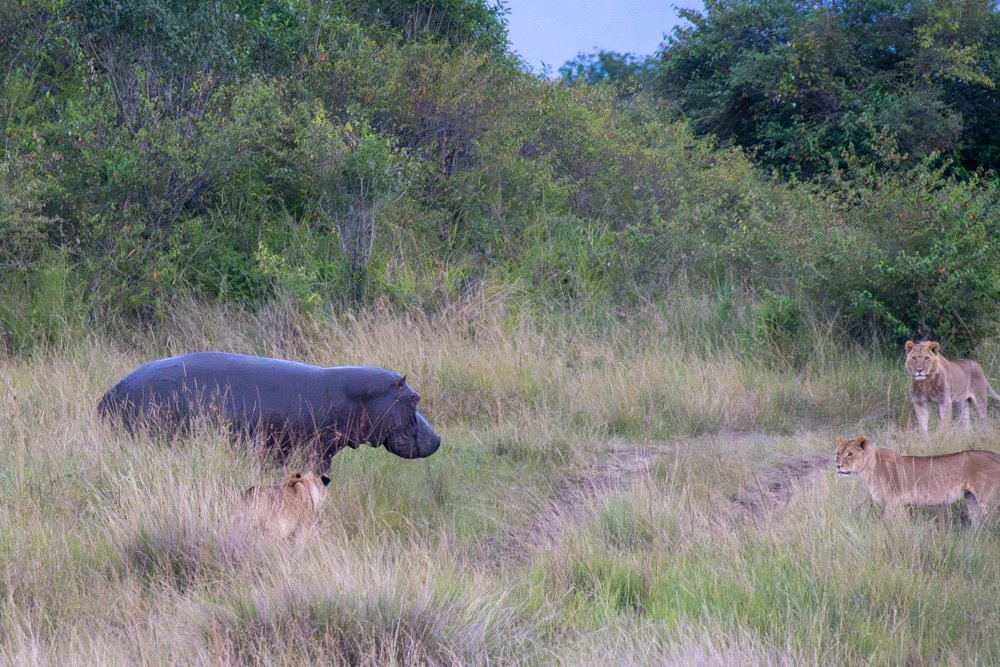
Male hippos mark their territory by flicking their poop with their tails. They can also open their mouths to an astonishing 150–180 degrees (humans can only manage about 26 degrees), creating an opening up to 4–5 feet wide.
Inside their mouths are massive canines, which can grow up to 20 cm, and incisors that can reach 16 inches. Their bite force is among the strongest of all land mammals, at 1,800 PSI—nearly twice as strong as an African lion and 600 PSI stronger than a polar bear.
The main ways people are killed by hippos are through drowning, being crushed, or from lacerations caused by their teeth.

What the Research Shows
In 2022, van Houdt and Traill published A synthesis of human conflict with an African megaherbivore; the common hippopotamus in Frontiers in Conservation Science, looking into human-hippo interactions. They note:
“A well-cited statistic states that more people are killed by hippopotamuses than by any other African animal, but very few data support this notion. Indeed, data published on human fatality in Africa through human-wildlife conflict show that bush elephants are responsible for more human deaths than hippos”.
The data that does exist reflects this. A 2012 paper published in the Journal of Ecology and the Natural Environment, Patterns of human–wildlife conflicts in Zambia: Causes, consequences, and management responses, looked at human-wildlife conflicts in Zambia from 2002 to 2010. They reported 65 people killed by hippos during this period, or about 10.8 people per year.
The 2016 IUCN Red List Assessment estimates the global hippopotamus population at roughly 114,300–130,000 individuals. Zambia’s population is 40,000–45,000, meaning about 35% of the global population resides there. Scaling this number suggests that worldwide, hippos could be responsible for roughly 38 human deaths per year. Even if we generously estimate 50 deaths per year, this is still far below the commonly cited 500–3,000.
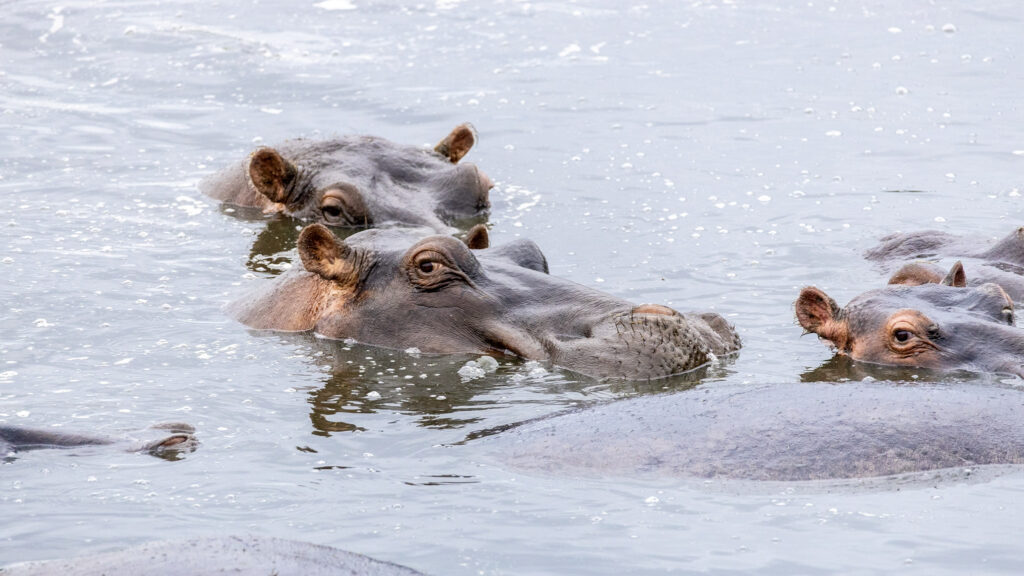
Hippos may not be the deadliest mammal in Africa by sheer numbers, but that doesn’t make them any less dangerous. While they kill fewer people than some other species, the severity of their attacks is striking. Van Houdt and Traill report that 87% of hippo attacks are fatal:
“While it may not be entirely factual to say that ‘hippos kill more people than any other animal in Africa,’ it is true that when hippo attacks do occur, the likelihood of death is high to very high. Further, survivors often suffer amputation and/or permanent disability”.

Other Dangers from Hippos
Researchers have identified another way hippos can threaten humans: anthrax. You might be imagining hippos somehow “mailing” anthrax to people, but the reality is far more unusual. During droughts or overpopulation, hippos graze on short grass, which can release anthrax spores from the soil. They may become infected by ingesting spores, through wounds from fights with other hippos, or by drinking contaminated water. Some researchers suggest hippos may even scavenge on other dead hippos. Researchers believe this behavior could contribute to the spread of anthrax. They note that buffalo and other potential anthrax hosts did not experience fatalities until later in the outbreak, and even then, their deaths were minimal compared with the hundreds of hippo fatalities.
Anthrax outbreaks among hippos have become an issue in Zambia, Uganda, Zimbabwe, the Republic of the Congo, and South Africa. In 2011, 85 hippos were found dead in Zambia, with overcrowding forcing animals to walk 30 kilometres just to feed. In 2004, an outbreak in Queen Elizabeth National Park, Uganda, killed 300 hippos. In 2017, over 100 hippos died in Namibia’s Bwabwata National Park, and most recently, in April 2025, 50 hippos were found dead in Virunga National Park, Republic of the Congo.
But how does this affect humans? In 2017, Lehman et al. reported that in September 2011, 511 human cases of anthrax and five deaths were recorded in Chama District, Zambia, near areas where hippos had died. Anthrax, caused by Bacillus anthracis, can infect humans through the skin, ingestion, or inhalation, causing symptoms from skin ulcers to severe respiratory or gastrointestinal illness.
A household survey revealed that 84% of respondents had eaten hippopotamus meat before the outbreak, and handling or consuming the meat was linked to infection. Despite the risks, 23% said they would eat meat from dead hippos again due to food shortages and protein scarcity. Chronic food insecurity drives consumption of unsafe foods, increasing the risk of zoonotic infections.
Hippo Safety
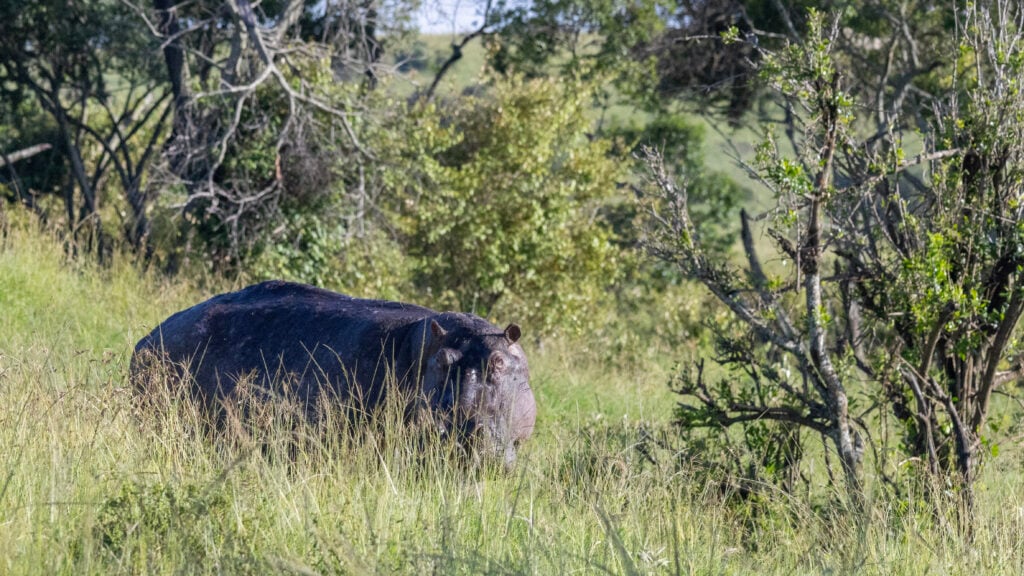
Hippos have a fearsome reputation and for good reason. They are powerful animals that deserve respect. People are most at risk when fishing, boating, or swimming in hippo habitats, and on land, they may charge anyone who gets too close, especially at dawn and dusk when they leave the water to graze. On safari, you will usually see them from a distance, from boats or vehicles, giving you the chance to admire their size, behavior, and presence up close. With respect and attentiveness to your guide’s instructions, you can appreciate the awe-inspiring presence of hippos without being fearful.
Avoiding Hippo Encounters:
- Do not walk along well-worn hippo paths.
- Stay close to your group at all times.
- Avoid approaching hippos from behind.
- Make your presence known if you are nearby.
- Avoid walking in hippo territory during dawn or dusk.
Recognizing Hippo Warnings:
- Agitated hippos may open their mouths wide in a yawn as an aggressive display.
- Watch for the head being thrown back, shaking, grunting, or snorting.
If Charged on Land:
- Like other ungulates, try to climb a tree or put an obstacle (rock, anthill, etc.) between you and the hippo.
- Never position yourself between a hippo and the water.
- If a hippo is charging, run parallel to the water source rather than away from it.
If in a Watercraft:
- Hippos usually give signs that they are approaching, such as a bow wave.
- Slapping the water may deter an approaching hippo.
- If knocked into the water, move away from the canoe—hippos target large shapes in their territory.
If Attacked in Water:
- If a hippo attacks, do everything you can to defend yourself. Remember, it’s not hunting you—it’s trying to drive you out of its territory.
- If dragged underwater, try to remain calm and breathe when at the surface.
References
Bhattacharya, S. (2004, December 20). Cannibalism may have spread anthrax in hippos. New Scientist. https://www.newscientist.com/article/dn6818-cannibalism-may-have-spread-anthrax-in-hippos/
Chomba, C., Senzota, R., Chabwela, H., Mwitwa, J., & Nyirenda, V. (2012). Patterns of human-wildlife conflicts in Zambia: Causes, consequences and management responses. Journal of Ecology and the Natural Environment, 4(12), 303–313. https://doi.org/10.5897/JENE12.029
Fair, J. (2024, April 11). What’s the most dangerous animal in Africa? – Discover Wildlife. BBC Wildlife Magazine. https://www.discoverwildlife.com/animal-facts/most-dangerous-animal-in-africa
Haddara, M. M., Haberisoni, J. B., Trelles, M., Gohou, J.-P., Christella, K., Dominguez, L., & Ali, E. (2020). Hippopotamus bite morbidity: A report of 11 cases from Burundi. Oxford Medical Case Reports, 2020(8), omaa061. https://doi.org/10.1093/omcr/omaa061
IUCN. (n.d.). Hippopotamus amphibius. Retrieved August 27, 2025, from https://www.iucnredlist.org/species/pdf/18567364/attachment
Lehman, M. W., Craig, A. S., Malama, C., Kapina-Kany’anga, M., Malenga, P., Munsaka, F., Muwowo, S., Shadomy, S., & Marx, M. A. (2017). Role of food insecurity in outbreak of anthrax infections among humans and hippopotamuses living in a game reserve area, rural Zambia. Emerging Infectious Diseases, 23(9), 1471–1477. https://doi.org/10.3201/eid2309.161597
Namibia: More than 100 hippos die in suspected anthrax outbreak. (2017, October 9). BBC. https://www.bbc.com/news/world-africa-41558385
Prada, L., Fike, A., Booth, V., Galiher, S. A., Boisvert, L., Franklin, A., & Koepp, B. (2025, April 9). Anthrax kills 50 hippos at Africa’s Virunga National Park. VICE. https://www.vice.com/en/article/anthrax-kills-50-hippos-at-africas-virunga-national-park/
rafferty, J. P., & Tikkanen, A. (n.d.). 9 of the world’s deadliest mammals. Britannica. https://www.britannica.com/list/9-of-the-worlds-deadliest-mammals
Reading is Fundamental. (n.d.). Leveled reading passage: Top-10 countdown: Africa’s most deadly animals (Hard). Reading is Fundamental. https://www.rif.org/literacy-central/reading-experience/leveled-reading-passage-top-10-countdown-africa%E2%80%99s-most-deadly-0
van Houdt, S., & Traill, L. W. (2022). A synthesis of human conflict with an African megaherbivore; the common hippopotamus. Frontiers in Conservation Science, 3. https://doi.org/10.3389/fcosc.2022.954722
World Organisation for Animal Health. (2010, August 4). Anthrax outbreak in Queen Elisabeth National Park in Uganda. https://rr-africa.woah.org/en/news/anthrax-outbreak-in-queen-elisabeth-national-park-in-uganda/